
Napoleon III & Opera Garnier: Why the Emperor Built the Most Opulent Opera House in the World
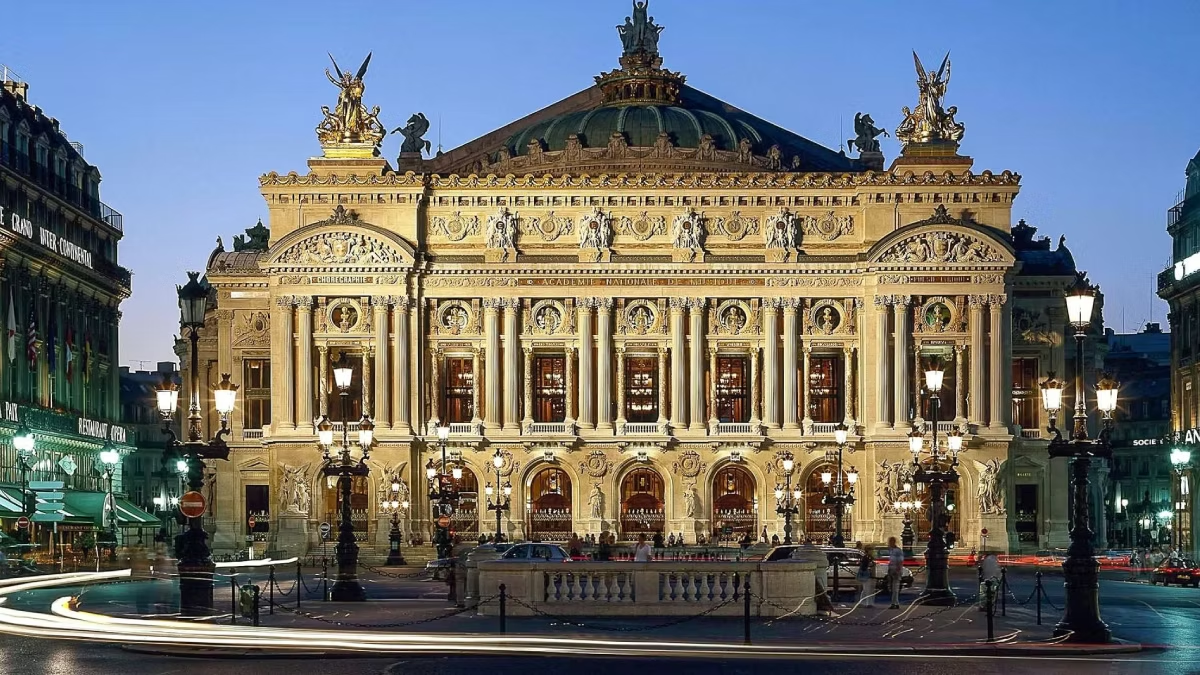
Napoleon III commissioned Opera Garnier in 1858, immediately following an assassination attempt at the existing opera house. The decision was political as much as cultural: a new, purpose-built opera house of unprecedented grandeur would demonstrate the permanence and confidence of the Second Empire, anchor Haussmann’s transformation of the 9th arrondissement, and provide a building worthy of France’s ambition to be the cultural capital of the world. Napoleon III never saw it completed — he died in exile in 1873, two years before the building opened.
Louis-Napoléon Bonaparte — Napoleon III — is one of those historical figures whose reputation has oscillated dramatically. Victor Hugo called him “Napoleon the Little” and wrote a blistering denunciation from exile. Later historians credited him with the modernisation of France’s economy, infrastructure, and urban fabric. The truth is characteristically complex: an autocrat who held power by plebiscite rather than legitimate hereditary right, who built railways and sewers and the Paris we recognise today, and who ended his rule as a prisoner of war, his empire collapsing around him at Sedan in 1870.
Opera Garnier is Napoleon III’s most visible surviving contribution to Paris — and it was completed, with magnificent irony, by the republic that replaced him.
The Second Empire and Haussmann’s Paris
Napoleon III’s Second Empire (1852–1870) oversaw the most radical transformation of a major European city in the 19th century. The prefect Baron Georges-Eugène Haussmann was commissioned to modernise Paris — demolishing medieval districts, driving broad straight boulevards through the city’s fabric, installing modern sewers and water supply, building new parks, hospitals, and public buildings. The grands travaux (great works) displaced hundreds of thousands of Parisians but created the city’s characteristic Boulevard architecture. Opera Garnier was the cultural centrepiece of this transformation — the monument that would anchor the new 9th arrondissement and announce France’s cultural ambition to the world.
Haussmann’s transformation of Paris between 1853 and 1870 was unprecedented in its scale and speed. He demolished roughly 20,000 buildings, displaced some 350,000 residents, and drove 137 km of new boulevards through the city. The resulting urban fabric — wide, straight, tree-lined boulevards flanked by uniform six-storey Beaux-Arts apartment buildings — is what most visitors now think of as “old Paris,” even though it was radically new in the 1850s and 1860s.
The new opera house was planned from the outset as a centrepiece of the northern Right Bank redevelopment. The Avenue de l’Opéra — Haussmann’s great new boulevard running south from the building to the Louvre — was designed specifically to frame the Palais Garnier at its northern terminus, visible from the Louvre’s courtyard nearly a kilometre away. The urban planning and the building were conceived as a single composition.
The Orsini Assassination Attempt
On the evening of 14 January 1858, Napoleon III and Empress Eugénie arrived at the Salle Le Peletier — Paris’s then-existing opera house — for a gala performance. As their carriages pulled up to the entrance, three bombs were thrown. The explosions killed eight people and wounded 156 others. Napoleon III and Eugénie were uninjured but deeply shaken.
The bomber, Felice Orsini — an Italian nationalist who believed that Napoleon III’s support was essential for Italian unification and that his assassination would advance the cause — was captured, tried, and guillotined. The letters he wrote to Napoleon III from prison, appealing for Italian independence, were so compelling that Napoleon III reportedly read them to his council of ministers and was moved by them. The subsequent French support for Italian unification — which contributed to the creation of the modern Italian state — is partly attributed to this encounter.
The Orsini attack had an immediate effect on the Salle Le Peletier’s reputation. The building’s entrance arrangements, on a narrow street with no open approach, had allowed the attacker to reach point-blank range of the imperial carriages. The new opera house, whatever else it was, needed to be designed with a security logic that the existing building entirely lacked.
The 1860 competition brief specified — among its detailed performance requirements — that the building must have an approach that allowed secure arrival for the head of state and distinguished guests, with the carriages, the security personnel, and the general public maintaining entirely separate routes. The split entrance arrangement of Garnier’s design — with the imperial entrance and the Avant-Scène box positioned for maximum security and minimum exposure — directly reflects the Orsini lesson.
Napoleon III’s Cultural Policy
The assassination attempt accelerated a decision that Napoleon III’s cultural policy had been moving towards in any case. The Second Empire’s cultural programme was explicit: France was the natural leader of Western civilisation, and its capital city must demonstrate that leadership in built form. The old Salle Le Peletier — cramped, fire-prone, and inadequate for the social requirements of the imperial court — was a standing embarrassment.
Napoleon III’s approach to cultural patronage combined genuine enthusiasm with political calculation. He supported the Salon des Refusés (1863) — the exhibition of work rejected by the official Salon, which launched Impressionism as a movement — while simultaneously commissioning the most conventionally grand public buildings money could provide. The contradiction was characteristic: a man who believed simultaneously in progress and in display.
Opera Garnier was the apex of the display ambition. The brief specified a building of 11,000 square metres that would be the largest opera house in the world — larger than La Scala, larger than Covent Garden, larger than anything Vienna had produced. The auditorium alone was to seat nearly 2,000 people. The public rooms were to be capable of receiving the full imperial court.
The Imperial Entrance That Was Never Used
Garnier included in his design a dedicated imperial entrance on the building’s eastern flank — a covered carriage approach that would allow Napoleon III to arrive at and depart from the opera without exposure to the street. The entrance opens directly onto a private staircase leading to the Avant-Scène boxes at stage level.
The imperial entrance was never used by Napoleon III. By the time the building opened in January 1875, he had been in exile for four years and was dead. The entrance remained unused as a state entrance throughout the building’s history — a ghost of the imperial purpose it was built to serve.
It remains accessible to visitors today and is pointed out by guides as one of the building’s most historically poignant features: Garnier’s most carefully designed security element, prepared for a patron who never arrived.
The Building as Political Monument
Understanding Opera Garnier as a political monument rather than merely a cultural institution changes how the building reads. The Grand Staircase is not just beautiful — it is a stage for the display of power and wealth that the Second Empire required its monuments to provide. The Grand Foyer is not just opulent — it is a space calibrated to hold the full court at interval, to make every aristocrat and minister feel that they are participating in something appropriately imperial.
The building was designed for a specific political order. That order collapsed before the building was complete. The Third Republic that opened Opera Garnier in 1875 had no emperor to fill the imperial entrance, no imperial court to promenade in the Grand Foyer, no Empress Eugénie to appear in the Avant-Scène box. The building’s social programme — so carefully designed around Second Empire ceremony — was immediately repurposed for the republican culture that replaced it.
This repurposing is, in retrospect, the building’s deepest architectural quality. Garnier designed a building so fundamentally well-suited to the social function of an opera house — any opera house, under any political system — that it survived the collapse of the regime that commissioned it and continues to operate 150 years later.
Frequently Asked Questions
Why did Napoleon III build Opera Garnier?
Napoleon III commissioned the new opera house for several interconnected reasons: to replace the inadequate and fire-prone Salle Le Peletier; to create a secure arrival point for the imperial court following the Orsini assassination attempt in 1858; to serve as the cultural centrepiece of Haussmann’s transformation of the 9th arrondissement; and to announce France’s position as the cultural capital of the world.
Did Napoleon III ever visit Opera Garnier?
Napoleon III never visited the completed building. Construction began in 1861 and was not complete when the Franco-Prussian War began in 1870. Napoleon III was captured at the Battle of Sedan in September 1870, the Second Empire collapsed, and he went into exile in England, where he died in 1873. Opera Garnier opened in January 1875.
What was the Orsini assassination attempt?
On 14 January 1858, the Italian nationalist Felice Orsini threw three bombs at Napoleon III’s carriages as they arrived at the opera, killing eight people and wounding 156. Napoleon III was uninjured. The attack accelerated the decision to build a new opera house with better security arrangements and influenced Napoleon III’s subsequent support for Italian unification.
What is the imperial entrance at Opera Garnier?
The imperial entrance is a dedicated covered carriage approach on the eastern flank of the building, designed to allow Napoleon III to arrive at and depart from the opera without exposure to the street. It leads directly to a private staircase and the Avant-Scène boxes. It was never used by Napoleon III, who never saw the completed building.
What was Haussmann’s role in Opera Garnier?
Baron Haussmann, Napoleon III’s Prefect of the Seine, oversaw the urban planning context for Opera Garnier rather than the building itself. He designed the Avenue de l’Opéra — the straight boulevard running south from the building to the Louvre — as a visual axis that frames the Palais Garnier at its northern terminus. The building and its boulevard were conceived as a single urban composition.
