
The Grand Foyer of Opera Garnier: Art, Architecture & What to Look For (2026)
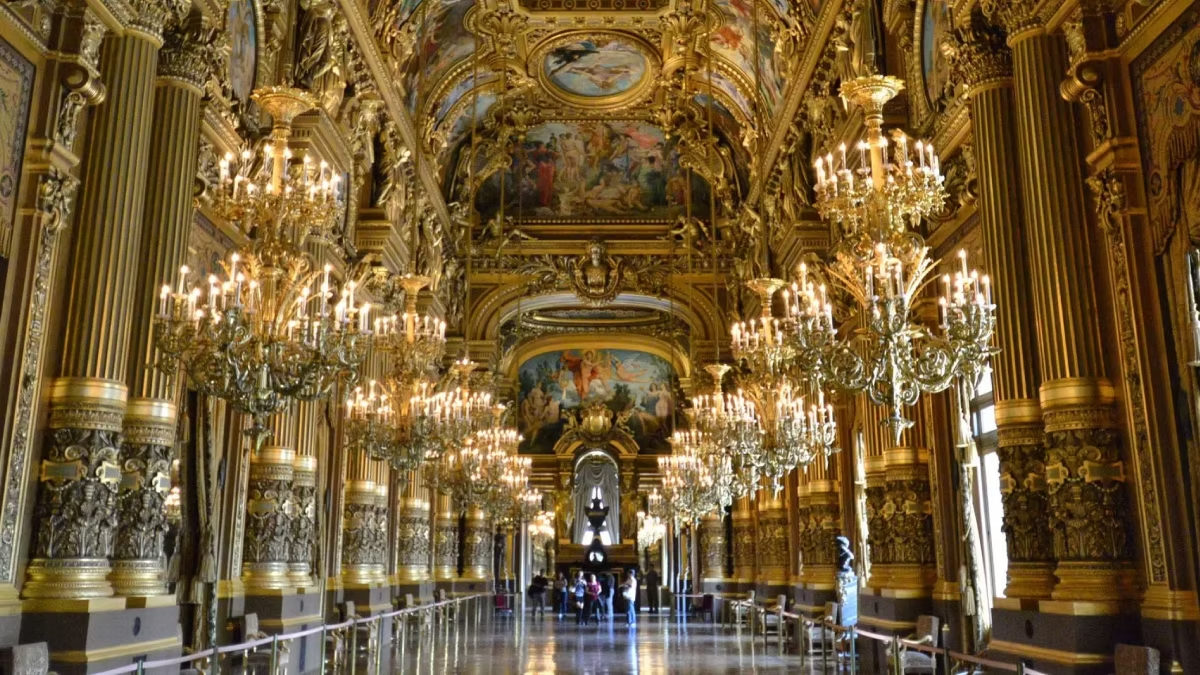
The Grand Foyer of Opera Garnier is a 54-metre gilded hall running the full width of the building’s main level, modelled in ambition on the Hall of Mirrors at Versailles. Its ceiling is painted with allegorical figures representing Music, Drama, Dance, and related themes by a team of French academic painters led by Paul Baudry. The floor is mosaic. The walls are lined with gilded pilasters, mirrors, and painted lunettes. It is the most elaborately decorated room in the building and the space that most completely realises Garnier’s vision of the opera house as total theatre.
After the Grand Staircase stops you at the threshold, the Grand Foyer is where Opera Garnier holds you. It is 54 metres long, 13 metres wide, and approximately 18 metres high — proportions that feel palatial without being oppressive. Every surface is decorated. The ceiling glows with painted allegories. The gilded pilasters catch the light from south-facing windows that bathe the room in warm Paris afternoon sun. The floor is an intricate mosaic that most visitors, looking upward, never examine.
Garnier himself called it “the principal room of the opera” — not the auditorium where the performances happened, but this foyer where the audience gathered, promenaded, argued, and displayed themselves in the intervals. The room was designed for performance. The performance was the audience.
Architecture and Proportions
The Grand Foyer of Opera Garnier measures 54 metres in length, 13 metres in width, and approximately 18 metres in height. It runs along the full south-facing front of the building above the main entrance, with large arched windows overlooking Place de l’Opéra. The ceiling is painted with allegorical figures by Paul Baudry. The floor is a polychrome mosaic. Gilded composite pilasters divide the wall bays, each bay containing a mirror or painted lunette. The room’s proportions and decorative programme were consciously designed to evoke — and rival — the Hall of Mirrors at Versailles.
The comparison to Versailles is not casual. Garnier was explicit about his reference: the Hall of Mirrors was the supreme statement of French royal power in architecture; his Grand Foyer would be the statement of French cultural power in the democratic age of the Second Empire. Both rooms use mirrors, gilding, large-format paintings, and abundant artificial light to create an atmosphere of overwhelming opulence. Both are designed to be experienced at night, with candles or gas jets playing off reflective surfaces.
The Grand Foyer surpasses Versailles in one specific respect: proportion. The Hall of Mirrors at 73 metres long is longer, but its ceiling height-to-width ratio is less dramatic. In the Grand Foyer, the relative narrowness of the room and the height of the ceiling create a sense of vertical compression that makes the painted vault feel immediately overhead — closer and more enveloping than the grander but more spatially diffuse Versailles hall.
The Ceiling Paintings
The ceiling programme was executed by Paul Baudry, one of the leading French academic painters of the second half of the 19th century, assisted by a team of painters over several years. The commission was to produce a unified allegorical programme covering the entire vault.
The paintings are organised around a central compositional axis from the main entrance end to the stage end. The central oval panels represent the principal arts of the theatre: Music (represented as a female figure with a lyre, compositionally derived from a Roman sculptural type Garnier had studied), Drama (tragic and comic masks, the classical theatrical duality), and Dance (figures in movement that presage, slightly uncannily, the ballet paintings Degas would begin making in the same decade).
The flanking panels represent the Muses, the seasons, and allegorical figures associated with the performing arts. The lunettes above the window bays represent historical and mythological scenes associated with the history of Western music — Orpheus, Apollo, Amphion. The whole programme is legible as a coherent theological argument for the centrality of music and theatre to civilised life. It is, in Garnier’s terms, the philosophical statement of which the building is the physical expression.
Most visitors don’t read the ceiling. Most visitors look at the gold. The audio guide covers the ceiling programme in enough depth to make it readable — see our audio guide article for what the Foyer narration covers, or book a private guided tour for full iconographic analysis.
The Floor
Almost nobody looks at the floor. This is understandable — the ceiling is overwhelming. But the Grand Foyer’s mosaic floor is itself an extraordinary piece of craft, covering the entire 54-metre length in a continuous polychrome composition of geometric and foliate patterns that provides a visual anchor for the room’s vertical excess.
The floor was designed to be seen from above — from the galleries and from the loggia overlooking the foyer — as much as from floor level. At floor level it reads as pattern; from above it reads as a coherent composition that mirrors, in horizontal form, the ceiling painting’s organisation above it.
Photograph it. Most visitors don’t.
The Windows and Light
The Grand Foyer’s south-facing windows are the building’s main concession to natural light. Five large arched windows overlook Place de l’Opéra, and the light they admit varies dramatically by time of day and season.
Morning (10:00–12:00): The sun is still in the east; light enters obliquely from the left (east) end of the room, creating shadows in the window bays but warm illumination on the gilded pilasters.
Midday (12:00–14:00): The highest and flattest light of the day. The room is most brightly lit but least dramatically so — the gold appears brightest but the paintings have least contrast.
Afternoon (14:00–16:00): The best light. The afternoon sun enters the south-facing windows more directly, flooding the room with warm gold-toned illumination that does precisely what Garnier intended the room to do. The gilded pilasters glow. The ceiling paintings catch the light differently by panel, creating a constantly shifting sense of the room’s depth. If you can visit in the late afternoon, the Foyer is at its most extraordinary between 14:30 and 16:00.
The Café de la Paix Connection
The Grand Foyer overlooks Place de l’Opéra, and the windows face directly towards the InterContinental hotel’s ground floor where the Café de la Paix operates. Both Garnier’s foyer and the Café de la Paix (designed in the same period by Charles Rohault de Fleury) are products of the same cultural moment — the Second Empire’s ambition to make Paris the most beautiful city in the world. Looking out from the Grand Foyer windows towards the café’s terrace is a view Zola, Maupassant, and half of Belle Époque Paris also enjoyed.
What to Look For: A Checklist
For visitors who want to engage actively with the Foyer rather than being passively overwhelmed by it:
The central ceiling oval: Identify the figure of Music — female, with a lyre, positioned at the central axis. Find Drama (masks) and Dance (figures in movement). Count the flanking Muses.
The pilaster capitals: Each gilded pilaster capital is carved with lyres, masks, and musical instruments — the standard decorative vocabulary of a music-themed building, executed with extraordinary care given that they’re 8 metres off the floor and most visitors never look at them.
The mirror bays: In the wall bays between pilasters, alternate panels contain mirrors and painted lunettes. Look at the mirrors obliquely to see the room’s full length reflected — a vertiginous effect that amplifies the spatial experience beyond the room’s actual dimensions.
The floor composition: Walk to the west end of the room and look back east along the floor. The mosaic composition reads differently from each end.
The window views: Look out of the windows at Place de l’Opéra and the Avenue de l’Opéra stretching away to the south. This is the view that Haussmann planned — the boulevard as a visual approach to the building you’re now inside.
Frequently Asked Questions
What is the Grand Foyer of Opera Garnier?
The Grand Foyer is the principal public room of Opera Garnier — a 54-metre gilded hall running the full width of the building’s main level, used as the primary promenade and social space for the audience between acts. Its ceiling is painted with allegorical figures by Paul Baudry. It was consciously designed to evoke and rival the Hall of Mirrors at Versailles.
How long is the Grand Foyer?
The Grand Foyer measures 54 metres in length, 13 metres in width, and approximately 18 metres in height. It is the longest room in the building accessible to daytime visitors.
Is the Grand Foyer the same as the Hall of Mirrors?
No. The Hall of Mirrors is at the Palace of Versailles. Garnier designed the Grand Foyer of Opera Garnier as a conscious reference to — and democratic-era rival of — the Hall of Mirrors, using similar elements (mirrors, gilding, large-format ceiling paintings, abundant light) in a proportionally different space. The Grand Foyer is smaller but, in the view of many architectural historians, more spatially intense.
What is painted on the ceiling of the Grand Foyer?
The ceiling paintings were executed by Paul Baudry and a team of French academic painters. The programme represents the principal arts of the theatre (Music, Drama, Dance) in the central panels, the Muses in flanking positions, and mythological scenes associated with the history of Western music (Orpheus, Apollo, Amphion) in the lunettes above the window bays. The full iconographic programme is covered by the audio guide and by private guided tours.
What is the best time of day to visit the Grand Foyer?
Late afternoon (14:30–16:00) offers the best light — the south-facing windows admit warm afternoon sun that illuminates the gilded surfaces and ceiling paintings as Garnier intended. Morning visits offer lower crowds. If both matter to you, visit the Grand Staircase at 10:00 (best crowd and overhead light) and reach the Grand Foyer by 14:30 after lunch. See our best time to visit guide for the full timing analysis.
