
Famous Performances & Milestones at Opera Garnier: A Cultural Timeline
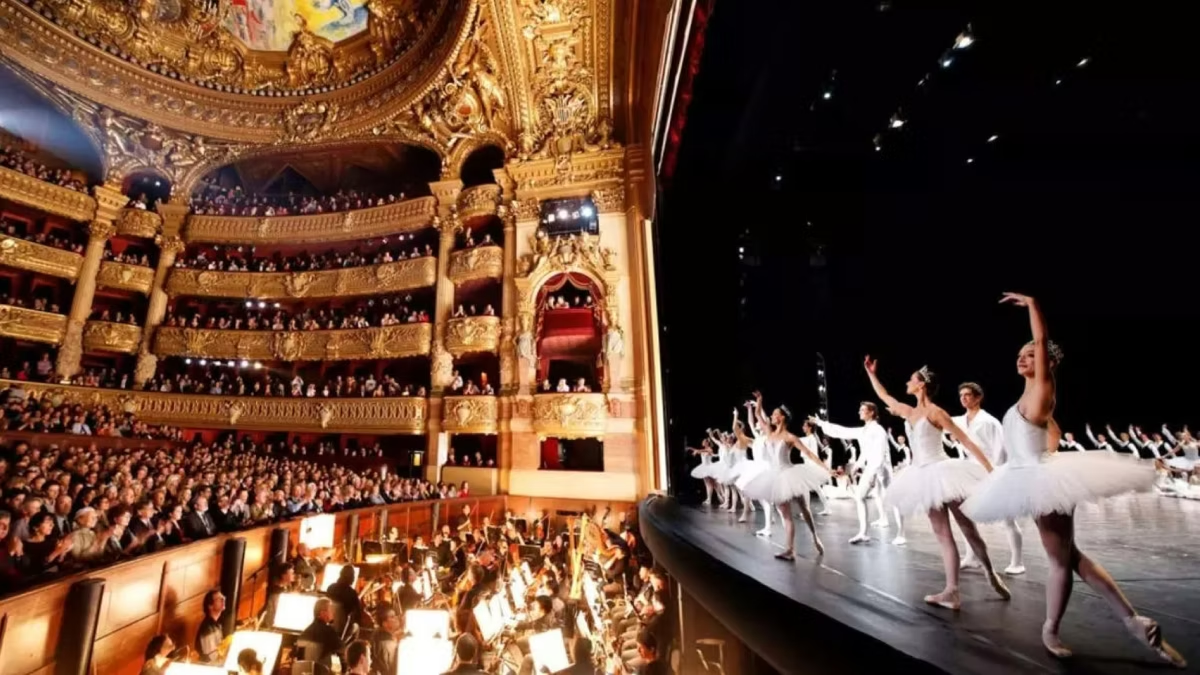
Opera Garnier has hosted world premieres and landmark productions across 150 years of continuous operation. Key milestones include the opening gala on 5 January 1875, the premiere of Massenet’s Manon (1884), Rudolf Nureyev’s transformative tenure as Paris Opera Ballet director (1983–1989), the unveiling of the Chagall ceiling (1964), and the building’s relegation to ballet-primary programming after the Opéra Bastille opened in 1989. The institution traces its lineage to Louis XIV’s Académie Royale de Danse (1661), making it one of the world’s oldest continuously operating performing arts organisations.
A visit to Opera Garnier is a visit to a building that has hosted some of the most significant moments in the history of Western performing arts. The performances that took place in this room — the premieres, the scandals, the triumphs, the debuts of legendary dancers and singers — form a cultural thread running from the Second Empire through the Belle Époque, two world wars, and into the present. Walking through the auditorium with even a partial knowledge of that thread changes how the space feels.
A Timeline of Key Moments
5 January 1875: Opening Night
The gala opening programme was a deliberately modest statement rather than a showcase: extracts from Halévy’s La Juive, Meyerbeer’s Les Huguenots, and Gounod’s La Reine de Saba, plus a ballet divertissement. The building’s technical systems had not been fully tested, and the artistic director chose caution over ambition for the first night.
French President Patrice de Mac Mahon attended in the place of the emperor who had commissioned the building — Napoleon III had died in exile two years earlier. The audience’s response to the building itself reportedly overshadowed the musical programme: contemporary accounts describe the staircase and Grand Foyer as overwhelming their first audience in precisely the way Garnier had intended.
1884: The Premiere of Massenet’s Manon
Jules Massenet’s Manon — now one of the most frequently performed French operas — had its world premiere at Opera Garnier on 19 January 1884, with Marie Heilbron in the title role. The opera was immediately recognised as a masterwork and established Massenet as the leading French opera composer of his generation. Manon has been performed at Opera Garnier in virtually every subsequent decade.
1890s: The Belle Époque and the Phantom Research Period
The decade in which Gaston Leroux researched and eventually wrote Le Fantôme de l’Opéra (published 1910) was also Opera Garnier’s social golden age. The attendance at the opera was as much a social as a musical event — the Grand Foyer hosted the negotiations and displays of the French upper classes, the subscription boxes were status markers, and the interval promenade was an institution.
The chandelier counterweight incident (1896) — in which a mechanism failure killed a concierge in the stalls during a performance of Meyerbeer’s Les Huguenots — occurred during this period. See our Phantom of the Opera article for the full account.
1909: The Ballets Russes
Sergei Diaghilev’s Ballets Russes made their Paris debut in 1909 — not at Opera Garnier initially, but at the Théâtre du Châtelet. The company subsequently performed at Opera Garnier from 1910 onwards. The Ballets Russes seasons — which introduced Stravinsky’s The Firebird (1910), Petrushka (1911), and The Rite of Spring (1913, at the Théâtre des Champs-Élysées), with choreography by Fokine and later Nijinsky, sets and costumes by Bakst and Picasso — represented the most concentrated burst of artistic revolution in the history of Western dance.
Diaghilev’s company was not the Paris Opera Ballet but a visiting company using Paris as its primary venue. The collision between Russian modernism and French operatic tradition in the space of Opera Garnier during this period is one of the formative events of 20th-century culture.
1964: The Chagall Ceiling
On 23 September 1964, André Malraux unveiled Marc Chagall’s painted ceiling in the Opera Garnier auditorium. The ceremony was attended by Chagall himself, by Malraux, and by the French president. The reaction was strongly divided: critics objected to the disruption of Baudry’s original 1874 ceiling, to the appointment of a foreign and Jewish artist to decorate France’s most national cultural monument, and to the modernist visual language in a neo-Baroque interior.
The ceiling has since been reassessed almost universally as one of Chagall’s greatest achievements and one of the most successful public art commissions of the 20th century. The controversy has receded; the painting remains. See our auditorium and Chagall ceiling article for the full artistic analysis.
1983–1989: Rudolf Nureyev as Director of the Paris Opera Ballet
Rudolf Nureyev — the Russian dancer who had defected to the West in 1961 at Orly Airport in one of the Cold War’s most dramatic cultural incidents — was appointed Director of the Paris Opera Ballet in 1983. His tenure until 1989 is considered the company’s most transformative modern period.
Nureyev brought international standards, international guest artists, and an ambitious programming approach that positioned the Paris Opera Ballet alongside the Royal Ballet and the Bolshoi as one of the world’s three pre-eminent classical companies. He staged complete productions of the great classical ballets — Swan Lake, The Sleeping Beauty, Don Quixote, Romeo and Juliet — with a theatrical vision that went beyond revival into reimagination. He also promoted a generation of French dancers — Laurent Hilaire, Sylvie Guillem, Manuel Legris — who defined the company’s identity for the following two decades.
Nureyev died of AIDS-related complications in January 1993. He is buried in the Sainte-Geneviève-des-Bois Russian Orthodox Cemetery outside Paris, under a mosaic-covered tomb.
1989: The Opéra Bastille Opens
The opening of the Opéra Bastille on 13 July 1989 — timed to coincide with the bicentennial of the French Revolution — fundamentally changed Opera Garnier’s role. The Bastille, with 2,745 seats and vastly superior technical facilities, took over the main opera programming. Opera Garnier was repositioned as the home of the Paris Opera Ballet and a venue for selected operatic productions.
The repositioning was not universally welcomed. Opera Garnier’s acoustic and atmosphere were considered superior by many musicians and opera-goers, and the political decision to build a populist “opera for all” in the 11th arrondissement rather than the 9th was seen by some as a deliberate displacement of the institution’s social function. The debate continues among Parisian opera audiences.
The Contemporary Era
Opera Garnier continues to host the Paris Opera Ballet’s full season and selected opera productions. Choreographers including William Forsythe, Pina Bausch, and Alexei Ratmansky have created works for the company at the Palais Garnier. The building remains one of the world’s most coveted performance venues — to dance on the Opera Garnier stage is a career milestone for any classical ballet dancer.
The Library-Museum: Where the Performances Are Documented
The Bibliothèque-Musée de l’Opéra, included in standard entry tickets, documents the full performance history of the Paris Opera — production photographs, costume archives, set models, and correspondence spanning 350 years of continuous operation. For visitors interested in the specific performances and milestones described above, the library-museum provides the archival context. See our library and museum article for what the collection holds.
Frequently Asked Questions
What famous performances have taken place at Opera Garnier?
Key milestones include the premiere of Massenet’s Manon (1884), the Ballets Russes Paris seasons (1910–1913), the unveiling of the Chagall ceiling (1964), and Rudolf Nureyev’s directorship of the Paris Opera Ballet (1983–1989). The full performance history spans 150 years and includes the premieres of major works in the French opera and ballet canon.
Who has performed at Opera Garnier?
Over 150 years, virtually every significant figure in Western opera and ballet has performed at Opera Garnier. Notable artists associated with the building include Rudolf Nureyev, Sylvie Guillem, Maria Callas (who performed several productions at the Palais Garnier), and the great Romantic ballerinas of the 19th century.
What is the Paris Opera Ballet?
The Paris Opera Ballet is the ballet company based at Opera Garnier and the Opéra Bastille. It is the world’s oldest national ballet company, tracing its lineage to the Académie Royale de Danse founded by Louis XIV in 1661. It maintains a company of approximately 150 dancers and performs a full season of classical and contemporary ballet each year.
When was Opera Garnier first used?
Opera Garnier opened on 5 January 1875 with a gala performance attended by the French President. The building had been under construction since 1861, with a 14-year construction period interrupted by the Franco-Prussian War and the Paris Commune.
Is Opera Garnier still used for opera performances?
Yes, though primarily as a ballet venue since the Opéra Bastille opened in 1989. Selected opera productions are performed at Opera Garnier each season, typically those that benefit from the building’s intimate scale and atmospheric interior — works that would be overwhelmed by the Bastille’s larger auditorium.
