
Accessibility at Opera Garnier: Wheelchair, Mobility & Disability Guide 2026
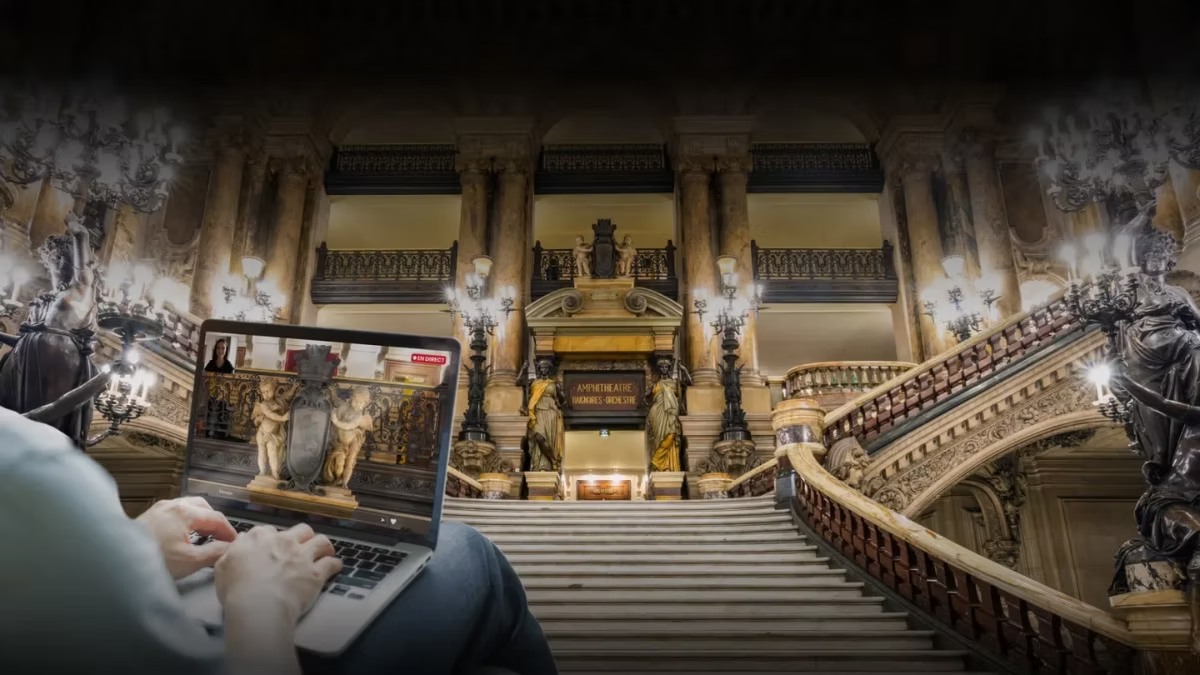
Opera Garnier is partially accessible. Lifts serve most of the main public floors, and adapted routes allow wheelchair users to visit the Grand Foyer and most of the main exhibition spaces. The Grand Staircase itself is not wheelchair-accessible — it exists to be walked, and there is no mechanical alternative. The auditorium has designated wheelchair spaces for performances. Contact the Paris Opera accessibility service in advance for a customised visit plan.
Visiting Opera Garnier with a disability or limited mobility requires some advance planning — the building is a 19th-century monument, not designed for modern accessibility standards, and some of its most famous features (particularly the Grand Staircase) are inherently step-based. That said, significant provisions are in place, and the majority of the public spaces are reachable for wheelchair users and visitors with reduced mobility.
This guide covers what is accessible, what is not, and how to get the most from the visit regardless of your needs.
Wheelchair Access and Adapted Routes
Opera Garnier has a dedicated accessible entrance and lift access to the main public levels. Wheelchair users enter via an adapted route rather than the main entrance steps, and lifts provide access to the Grand Foyer level, the rotonde de l’Avant-Foyer, and the museum spaces.
What is accessible by wheelchair:
- The Grand Foyer and its full length
- The Avant-Foyer and connecting salons
- The Opera Library and Museum on the ground level
- The auditorium (for performances) via designated lift access
- The gift shop and cloakroom areas
What is not fully accessible:
- The Grand Staircase — the primary staircase is not wheelchair-accessible and there is no mechanical bypass that delivers the same visual experience
- Some of the upper-level salon galleries
- The rooftop terrace (when open) — stairs-only access
For wheelchair users, the adapted route allows you to reach and experience the Grand Foyer — one of the building’s most spectacular spaces — and the museum. You will not be able to ascend the Grand Staircase in a chair, but you can view it from the lower level, which gives you the full sense of its scale and grandeur.
Opera Garnier is partially accessible for wheelchair users. Lifts serve most main public levels, including the Grand Foyer and the Opera Library. The Grand Staircase is not wheelchair-accessible. The auditorium has designated wheelchair spaces for performance evenings. Visitors with accessibility requirements are strongly advised to contact the Paris Opera accessibility team before visiting to arrange an adapted itinerary and ensure lift availability on the day.
Hearing Accessibility
Opera Garnier provides hearing loop (induction loop) systems in the auditorium for evening performances. Visitors with hearing aids set to the T-position can use this system at compatible seats. Contact the box office when booking performance tickets to request hearing-adapted seating.
For daytime visits, the audio guide is available in multiple languages. There is no BSL or LSF-interpreted guided tour as a standard offering, but this can sometimes be arranged for group visits through the accessibility service — contact the opera house in advance.
Visual Accessibility
For visitors with visual impairments, the audio guide provides a rich description of the spaces and their history. The guide covers the Grand Staircase, Grand Foyer, and auditorium in particular detail, describing the decorative programme, the Chagall ceiling, and the architectural logic of the building.
Touch programmes — allowing visitors to handle scale models of architectural elements — are available on request for some school and group visits. Individual visitors with visual impairments should contact the accessibility service in advance to discuss what provisions can be made.
Handrails are present on all staircases and in the main public areas. The flooring transitions between materials (marble, carpet, parquet) are generally well-signposted by texture changes underfoot.
Mobility and Physical Considerations
Walking distances: A full daytime visit covers a significant distance across multiple levels. The round-trip from the entrance to the Grand Foyer and back involves roughly 200–250 steps if the Grand Staircase route is taken. The lift alternative reduces this but the building still requires meaningful walking.
Seating: Benches and occasional chairs are available in the Grand Foyer and some of the salon spaces. If you need to rest frequently, the visit is still manageable — the pace is entirely self-directed and there is no guided queue to keep up with.
Toilets: Accessible toilets are available on the ground level near the main entrance.
Floor surfaces: The majority of the visit takes place on polished marble, which can be slippery, particularly if wet from foot traffic on rainy days. Flat, rubber-soled shoes are strongly recommended. Visitors using walking frames or mobility aids should be aware that marble offers less grip than most indoor flooring.
Advance Booking and the Accessibility Service
The Paris Opera has a dedicated accessibility team — Délégation à la Médiation Artistique — that coordinates adapted visits and performance accommodations. Contacting them before your visit is strongly recommended if you have specific requirements, particularly for wheelchair access where lift availability on a given day needs to be confirmed.
For daytime visits: Contact the Paris Opera accessibility service via the official Paris Opera website at least one week before your planned visit. They can arrange an adapted itinerary, confirm lift status, and advise on the best time to visit based on crowd levels.
For evening performances: Accessible seating must be booked through the box office rather than through third-party ticket platforms. State your specific requirements at the time of booking.
Companions: Visitors with disabilities are typically entitled to bring one companion who benefits from a reduced or complimentary ticket. Confirm this with the accessibility team when booking.
Reduced Admission
Visitors with recognised disabilities are entitled to a reduced admission price for daytime visits. The standard reduced rate applies. A companion travelling with a visitor with a disability may also be eligible for a concessionary rate. Proof of disability (such as an official disability card) is required at the ticket desk.
For full pricing details including concessionary rates, see the tickets and prices overview and the free and discounted entry guide.
Tips for Visitors with Limited Mobility
Visit in the morning. The building is less crowded between 10:00 and 11:30, which means more space on the accessible routes, shorter waits for lifts, and a calmer overall environment. This is particularly important for wheelchair users, where crowding in the staircase hall or foyer can make navigation more difficult.
Allow extra time. The adapted routes are slightly longer than the standard routes, and navigating lifts in a 19th-century building always introduces unpredictability. Allow 30 minutes more than the standard visit duration estimates.
Call ahead if the auditorium is a priority. Auditorium access for daytime visits is not guaranteed (see how long to spend at Opera Garnier for the impact of rehearsal schedules). If accessing the auditorium is particularly important to you — especially if you require specific lift access — confirm availability with the opera house the day before.
Frequently Asked Questions
Is Opera Garnier wheelchair accessible?
Partially. Lifts serve the Grand Foyer level and most main public spaces. The Grand Staircase is not wheelchair-accessible. The auditorium has wheelchair spaces for evening performances. Advance contact with the Paris Opera accessibility service is recommended.
Are there accessible toilets at Opera Garnier?
Yes. Accessible toilets are available on the ground level near the main entrance.
Can I bring a mobility scooter to Opera Garnier?
Contact the accessibility service in advance. The building’s floor surfaces and lift sizes may limit mobility scooter use in some areas. Manual wheelchairs are well-accommodated on the accessible routes.
Is there a hearing loop at Opera Garnier?
Yes, in the auditorium for evening performances. Visitors with T-compatible hearing aids should request hearing-loop seats when booking their performance tickets.
Does Opera Garnier offer free entry for carers or companions?
Companions of visitors with disabilities may be eligible for a reduced or complimentary ticket. Confirm current policy with the accessibility service or the ticket desk when visiting.
